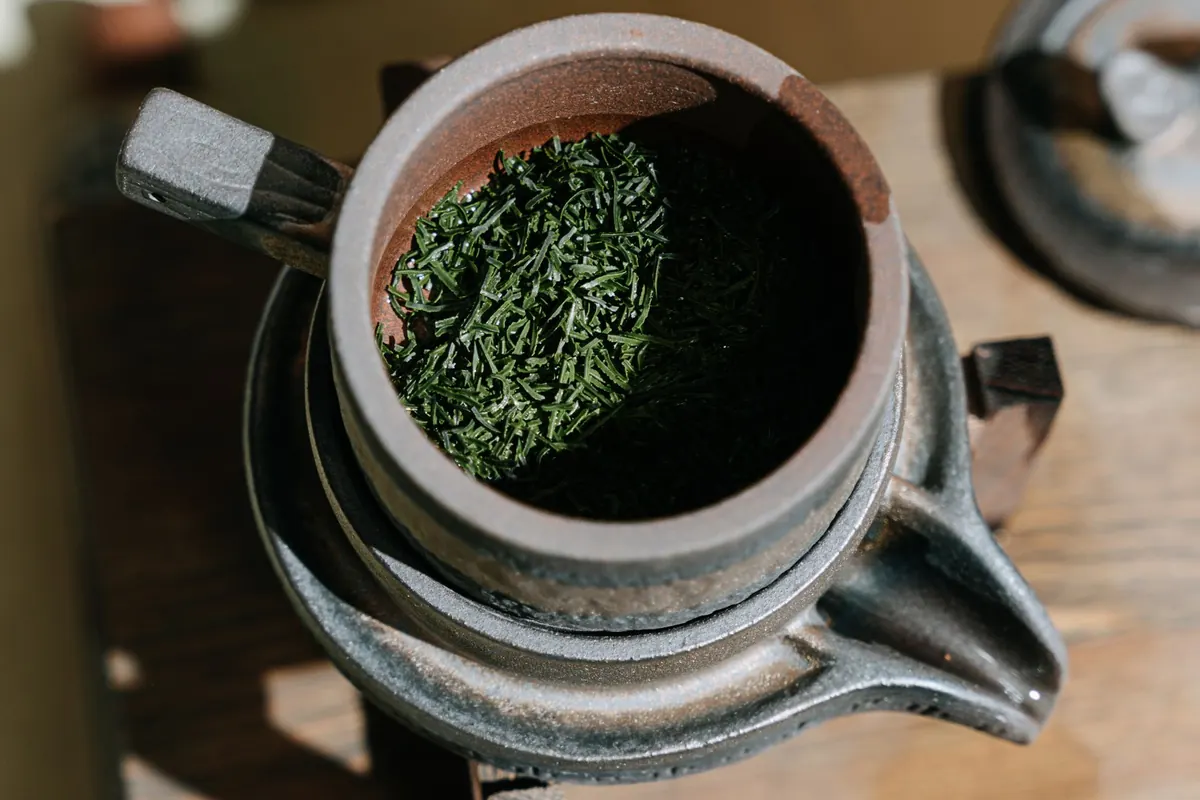
Two teas can come from the same bush, picked on the same morning, and taste nothing alike. One is bright and grassy; the other is dark, malty, and smells faintly of cocoa. The difference is not the plant. It is what happens to the leaf after plucking, and the single biggest lever is oxidation.
Understanding that one process makes the tea wall at a shop legible. You stop memorizing names and start predicting flavor.
What Oxidation Actually Means in Tea
Inside a living tea leaf, enzymes and polyphenols sit in separate compartments. Nothing reacts. The moment the leaf is bruised, rolled, or crushed, those compartments break and the two meet. Oxygen does the rest: the polyphenols, mainly catechins, convert into larger, darker compounds. The leaf shifts from green to copper to near-black, and the taste moves from vegetal toward fruity, floral, honeyed, or malty.
Two things control how far that goes. Bruising decides how fast and how deep the reaction runs. Heat stops it cold, because steaming or pan-firing denatures the enzymes. Tea makers use both to steer a batch toward a target.
A note on vocabulary: the tea trade often calls this "fermentation." It is not fermentation in the brewing or sourdough sense. True microbial fermentation happens in dark teas like pu'er, where mold and bacteria work on the leaf over months or years. Oxidation is chemistry with oxygen, and it happens in hours.
Oxidation is not a quality ladder. It is a dial, and every setting has something worth drinking.
The Spectrum at a Glance
Most teas fall along one line, from almost no oxidation to nearly complete:
- Green tea — near zero. Heated within hours of picking.
- White tea — roughly 5 to 10 percent, from a long wither. Never rolled.
- Yellow tea — low, with a slow covered step that softens the grassiness.
- Oolong — anywhere from 10 to 80 percent. The wide middle.
- Black tea — 80 to 100 percent. Fully oxidized before drying.
Dark teas sit off to the side. They are oxidized lightly and then fermented, which is a different process with a different result.
White Tea: Withered, Not Bruised
White tea is the least handled. Buds and young leaves are spread out to wither, sometimes for a day or more, then dried. There is no rolling, so cell damage stays minimal, but a long wither is not nothing. Slow moisture loss lets a small amount of oxidation happen on its own, which is why good white tea tastes rounder than green.
Expect hay, honey, and melon, with a soft body that thickens as the tea ages. Silver Needle, all buds, is the most delicate. White Peony, which includes a few open leaves, carries more weight. Aged white tea drifts toward dried fruit and herbal notes.
Green Tea: Stopped Before It Starts
Green tea takes the opposite approach: act fast. Within hours of picking, leaves hit a hot wok or a steam tunnel. The heat kills the enzymes and oxidation never gets going, so everything you taste comes from the leaf itself.
That is why green tea is so sensitive to water temperature. High heat pulls out bitterness that nothing else is hiding. Chinese greens like Longjing are pan-fired and toasty; Japanese greens like sencha are steamed and marine, with a brothy quality. Keep water around 160 to 175°F and steep briefly.
Oolong: The Wide Middle
Oolong is where oxidation becomes an art rather than an on-off switch. Leaves are tossed and bruised, traditionally in a bamboo drum, then left to rest while the maker watches and smells. When the aroma hits the target, heat stops the process. Some batches are shaped and roasted afterward, sometimes repeatedly over months.
This is why two oolongs can seem like different drinks. A light Tieguanyin, oxidized perhaps 20 percent, is floral and buttery. A roasted Wuyi rock tea, oxidized much further, is mineral, dark, and toasty. Oriental Beauty runs high and tastes of honey and muscat.
If you try only one category to understand the spectrum, make it oolong. Buy a light one and a dark one and taste them back to back.
Black Tea: Oxidized to the End
Black tea is rolled or crushed to break the leaf walls thoroughly, then left in a humid room until the color turns copper. By the time it is fired dry, nearly all the catechins have converted. The body is fuller, the astringency rounder, the aromatics deeper.
In China this is hong cha, "red tea," named for the liquor rather than the leaf. The range is still wide: a brisk, muscatel first-flush Darjeeling, a malty Assam, a smoky Lapsang Souchong, a sweet, cocoa-ish Keemun. Black tea tolerates near-boiling water and takes milk without collapsing.
Matching Oxidation to Your Brewing
As a rule, the more oxidized the leaf, the hotter the water and the longer it can steep:
- White: 175–185°F, 2–3 minutes.
- Green: 160–175°F, 1–2 minutes.
- Oolong: 185–205°F, 30 seconds to 1 minute, then re-steep.
- Black: 200–212°F, 3–4 minutes.
These are starting points, not rules. If a cup tastes harsh, cool the water or shorten the time. If it tastes thin, go the other way.
Tasting the Spectrum at Home
You do not need a shelf of equipment to feel the difference. Pick four teas across the range, a green, a white, a light oolong, and a black, and brew them one at a time in the same mug with the same amount of leaf. Write down three words for each. The gap between the green and the black is the whole lesson: grass and broth at one end, malt and dried fruit at the other, with the oolong showing how the flavor travels in between.
Once you have that map in your head, shopping gets easier. If you like the honeyed middle of a light oolong, a high-oxidation oolong or a black tea is a stretch in a direction you already enjoy. If you love the snap of a green, stay low and look for fresh harvests.
And when you find a tea you love, brew it twice at different water temperatures. Oxidation sets the range. Your kettle decides where in that range you land.
Photo: Ivan S / Pexels